

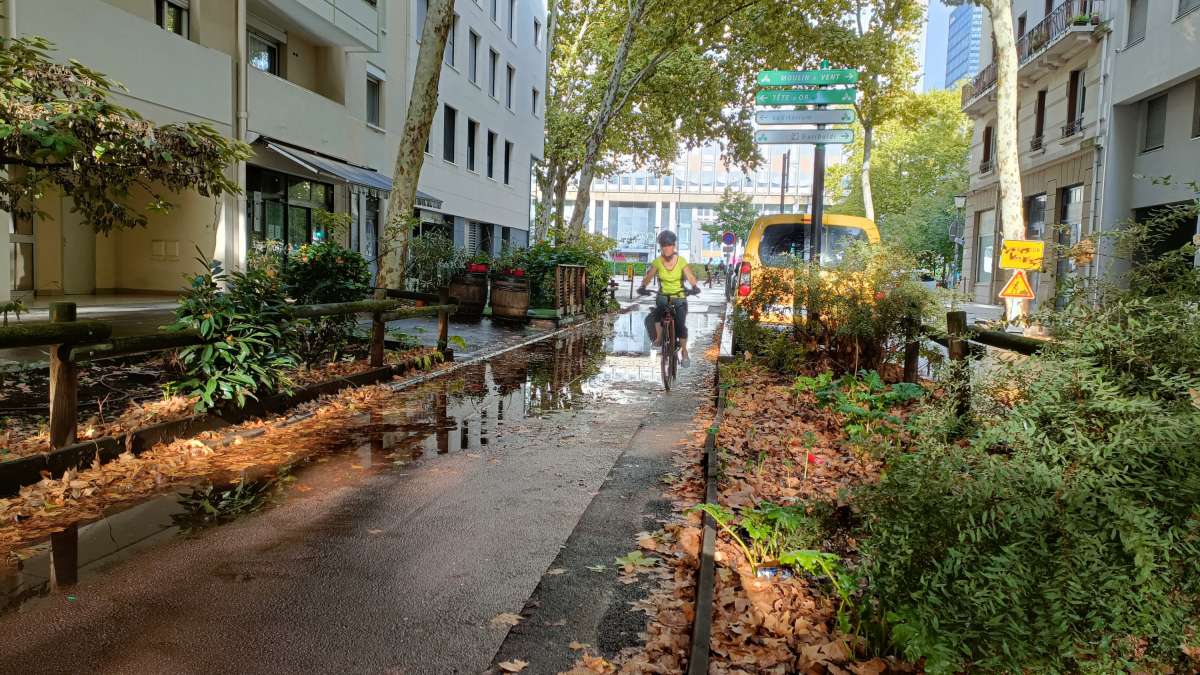
The adaptation and design of robust and resilient mobility facilities and services are now proving essential to support the roll-out of active mobility.
The resilience of facilities for active modes of transport: what are the challenges?
Cyclists and pedestrians are, in fact, users of public space who are particularly vulnerable to the effects of climate change. Policies aimed at increasing the modal shift towards active mobility require the design of walkable and cycle-friendly infrastructure that guarantees an adequate level of safety and comfort for users, even during major weather-related disruptions such as heavy rain, flooding, heatwaves, hailstorms and strong winds…
However, with global warming, some of these phenomena are set to intensify, or even occur more frequently and erratically, which may disrupt active mobility practices and affect the management of this infrastructure. How, then, can we ensure that facilities for active mobility remain both robust and attractive over time? What technical solutions and adaptation strategies should be implemented to reduce the observed and foreseeable vulnerabilities of pedestrians and cyclists? What best practices are already in place and should be replicated in the face of escalating climate risks?
Launched in November 2025 for a duration of three and a half years, the Interreg Streets2030 project aims to design, plan and evaluate cycle and pedestrian routes that are more resilient and better adapted to the aforementioned climate changes. The ultimate objective is to strengthen local capacity to adapt active mobility networks to the challenges posed by climate change. Led by Cerema, which is responsible for its coordination and management, this project brings together six local authorities from north-western Europe (the Netherlands, Ireland, Belgium, France and Germany), as well as two technical partners, the Belgian Road Research Centre (CRRB) and the Polis network of European local authorities.
A multidisciplinary project promoting cross-cutting approaches
The approach of the Streets 2030 project, which will run for 41 months, aims in particular to propose a methodology for assessing the resilience of infrastructure dedicated to active transport modes, based on a multidisciplinary and cross-cutting approach that goes beyond traditional technical ‘skill-by-skill’ and ‘siloed’ approaches.
To this end, the approach adopted within the Streets2030 project is structured around three main phases:
An exploratory approach addressing a pressing need among local authorities
The Streets2030 project will be implemented primarily in urban environments, where the challenges of developing active mobility and calming traffic are particularly pressing. As such, Streets2030 also focuses on the services associated with these modes of transport and on more specific intermodal hubs such as transport interchanges, bus stops and tram stations, where issues of passenger comfort and accessibility are crucial. Streets2030 also aims to extend its recommendations to local authorities – both small and medium-sized – located away from major urban centres, thanks to the inclusion in the consortium of a local authority (the Department of Haute-Saône), which enables technical trials specifically focused on active mobility in these areas.
At the intersection of mobility and infrastructure issues, the project also raises the question of the ecological transition of urban roads and public spaces. Environmental concerns regarding the fight against urban heat island effects and the reduction of flood risks are, in fact, prompting planners, on the one hand, to take greater account of green spaces in their considerations regarding the sharing of roadways and, on the other hand, to provide more permeable surfaces.
A pilot area deeply concerned with the adaptation measures required to tackle climate change
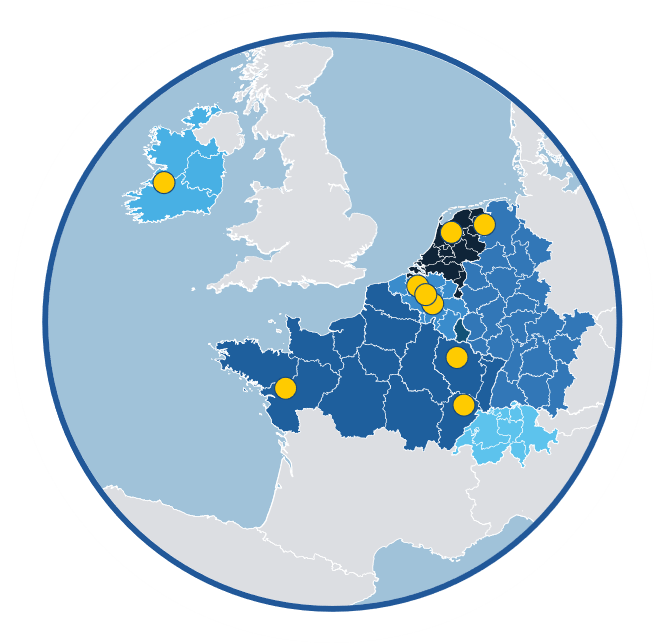
Located in north-western Europe, the project’s partner local authorities – Breme (Germany), Galway (Ireland), Leeuwarden (Netherlands), Sint-Niklaas (Belgium), Nantes Métropole and the Haute-Saône Department (France) – face very different challenges regarding mobility and climate resilience from one region to another. Nevertheless, they share a common aspiration: to capitalise on existing knowledge and technical expertise and thereby pave the way for an active mobility system that will benefit the city of tomorrow – including walkable and cycle-friendly infrastructure, more efficient and resilient mobility services, and an enhanced travel and user experience for pedestrians and cyclists throughout their journeys.
Organisation of a kick-off seminar in Lille
On 11 and 12 February 2026, Cerema organised an initial technical seminar in Lille with all stakeholders, providing an opportunity to discuss collectively the expectations of the partner local authorities and to agree on the organisation of the work and the expected outcomes. Cerema and the CRR took the opportunity to present several proposals for tools and methods they have developed, which could be utilised and adapted for the benefit of the project (ASAIT method, resilience compass, equipment and measuring instruments, etc.).